My dog is going blind due to progressive retinal atrophy - is gene therapy an option?
Billie Beckwith-Cohen, DVM, MBA, PhD, FAAO, DACVO
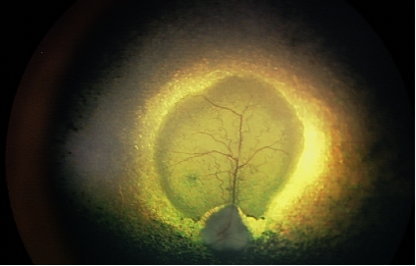
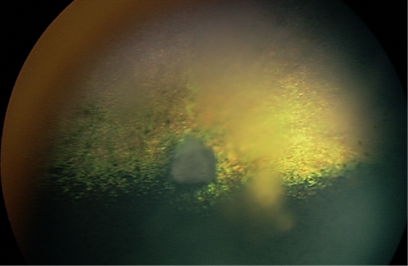
Retinal gene therapy in the dog: two photos showing the retina of the right eye (pictured on the left) and left eye (pictured on the right) of a dog that was treated with gene therapy after the diagnosis of progressive retinal degeneration. The area that was treated in the right eye did not degenerate and vision was saved, while the retina of the left eye, and untreated regions in the right eye went on to degenerate. Some haziness in the left eye is due to a small secondary cataract.
Some of you may have read about research that has been done on blind dogs that recovered their vision using a method called gene augmentation therapy. Such research in dogs has led to advanced therapies for children with blindness and some of these treatments are offered to children across the world. Periodically, we receive calls or emails from clients inquiring about vision rescuing therapies for their dogs that have been diagnosed with blindness, commonly due to Progressive Retinal Atrophy, or PRA. Answering the question whether this treatment path is an option for your dog is complex and this article will attempt to address key components to answer your question.
Is gene therapy available for my dog?
While the sections below offer insight into the suitability of this type of therapy for various patients, the most important thing to understand is that currently retinal gene therapy is only available in two centers in the United States, or worldwide (Michigan State University and the University of Pennsylvania), and this availability is entirely within a research-based setting. This means that treatment is not routinely provided to client owned dogs and is geographically or logistically inaccessible for most. Nonetheless, if you are highly motivated, and your dog is otherwise suitable for therapies that have been developed you could inquire directly with the laboratories conducting vision rescuing treatments in dogs, or have your veterinary ophthalmologist reach out directly to these labs and inquire on your behalf.
What problems does gene therapy treat?
Most gene therapies that have been developed for dogs treat inherited retinal diseases that cause blindness or severe vision impairment. As the name implies, gene therapy treats a genetic problem, and each one of these therapies treats mutations in a specific gene. Gene therapies are available for approximately one dozen blinding retinal diseases. Because the treatment is gene specific, each therapy that was developed can only treat mutations in one gene- this means that if the genetic cause is unknown or has not had a treatment developed then treatment is not an option. The first step in determining if a mutation is treatable or not is finding out which mutation, if any, your dog has. If your dog has been diagnosed with PRA your veterinary ophthalmologist or veterinarian can recommend a comprehensive genetic panel to test for known mutations that cause PRA in dogs. Most of these tests are purchased directly by the consumer and are easy to perform at home. Of note, a mutation in prcd is perhaps the most common mutation affecting many dog breeds, and is only included in select panels, therefore it is important to choose a panel that is right for your dog and their breed.
Can gene therapy be done at any age?
Many retinal degenerations are called progressive retinal atrophies (PRAs) because they get worse over time. At times, the condition has progressed significantly and to the point where secondary changes are noted in the eye including blinding cataracts. For dogs with cataracts an electroretinogram (ERG) must be performed to evaluate if there is sufficient retinal function for gene therapy to be successful. For gene therapy to work sufficient retinal structure needs to be preserved. Forms of PRA that are slow to progress or diagnosed incidentally during an exam or genetic screening are more likely to be successfully treated if addressed early on. While some forms of gene therapy are being studied for diseases where the retina has lost all function, such as Sudden Acquired Retinal Degeneration (SARDs), they are still in early exploratory phases of research. Of note, there is a small subset of inherited degenerations due to mutations where the electroretinogram is never developed, but vision can still be saved. This complexity in patient selection emphasizes the need for correct identification of the affected gene, and in depth discussion with a veterinary ophthalmologist.
Are there any other treatment options?
Progressive retinal atrophies and inherited retinal degenerations have no treatment aside from those that address the underlying genetic abnormality. Oral supplements intended for ocular health have not been scientifically proven to improve retinal function, and in certain cases in people it is shown that some could potentially have deleterious effects on the retina. As many of these conditions start with vision impairment in dim light settings, introducing bright motion detection lights and restricting walks to daytime hours can improve your dog’s quality of life while they adjust. Other lifestyle changes can help, and there are websites with dedicated information to help navigate living with a blind dog. It is important to remember that dogs have a phenomenal sense of smell and hearing that help them navigate even if their vision is poor. For these dogs it is even more important to keep up with their routine medical appointments and make sure that ear infections do not go untreated. Most dogs remain happy and enjoy an excellent quality of life even when blind, so long as they continue to receive your love and care.